Low-Sodium Slow Cooker Dinners: Keep the Flavour, Lose the Salt Load
This article is general cooking information, not medical advice. Sodium targets are a personal health matter, anyone managing blood pressure, kidney disease, or another condition should follow the guidance of their own clinician or dietitian, whose numbers for them may be lower than the general figures quoted here.
Most low-sodium recipe collections fail at the shopping cart, not the stove. They hand you finished recipes and send you to the store, where a carton labelled "reduced sodium" broth sits beside one labelled "low sodium" and a third promising "no salt added", three different claims that sound interchangeable and are not. Meanwhile the slow cooker itself works against you in a specific way: hours of sealed, gentle cooking mellow herbs and spices, so a dinner seasoned timidly at 9 a.m. tastes washed out by six. This guide works the problem in the order it actually occurs. First the numbers and the label terms, so any product can be judged on the shelf. Then an audit of where sodium hides in a slow cooker dinner. Then the part the collections skip: a flavour system built for the long cook, finished bright at the end.
Start with the numbers: the budget and the label terms
The National Heart, Lung, and Blood Institute (NHLBI), citing the 2020 to 2025 Dietary Guidelines for Americans, puts the general adult limit at less than 2,300 milligrams of sodium per day, about one teaspoon of table salt in total, from every source. University of Illinois Extension, citing the CDC, adds the context that makes the limit feel less abstract: average intake runs about 3,400 milligrams a day, and most of it arrives inside processed and restaurant food rather than from the salt shaker. A single slow cooker dinner is one meal of three, so a useful home rule of thumb is to build dinners that land well under a third of the daily budget and to read every label against that arithmetic.
| Label term | What it actually means (per serving) |
|---|---|
| Sodium-free | Less than 5 mg of sodium, and no sodium chloride |
| Very low sodium | 35 mg or less |
| Low sodium | 140 mg or less |
| Reduced / less sodium | At least 25% less than the regular version of the same product, which may still be a large number |
| No salt added / unsalted | No salt added in processing; the ingredient's natural sodium remains |
The trap sits in the fourth row. "Reduced" is a comparison, not a level: a broth cut by a quarter from a very salty starting point can still carry several times the sodium of a genuinely low-sodium broth at 140 milligrams or less per serving. The American Heart Association label definitions summarised by UofL Health give the shopper the only tool that cuts through all of it, ignore the front-of-pack adjective, read the milligrams per serving on the Nutrition Facts panel, and multiply by the servings the recipe will actually use.
The audit: where sodium hides in a slow cooker dinner
| Source in the pot | Why it adds up | The swap |
|---|---|---|
| Broth or stock | It is the cooking liquid itself, every serving of the finished dish carries it | Low-sodium or no-salt-added broth; the cook, not the carton, controls the final seasoning |
| Seasoning packets (taco, pot roast, BBQ, soup mixes) | Formulated for shelf-stable punch; the NHLBI names spice blends and soup mixes among the salty seasonings to limit | A homemade blend of garlic powder, onion powder, smoked paprika, herbs, and pepper, full flavour, no salt unless you add it |
| Canned tomatoes and beans | Canning liquid carries added sodium into the dish | No-salt-added cans where available; drain and rinse beans. Extension guidance notes rinsing canned beans, corn, or tuna under running water removes some of the sodium |
| Sauces and condiments | Soy sauce, barbecue sauce, ketchup, and hot sauce are concentrated; the NHLBI advises limiting condiments generally | Measure rather than pour, choose low-sodium versions, and let acid (below) do the brightening instead |
| Cheese, cured meats, pickled add-ins | Ham, sausage, bacon, olives, pickles, and sauerkraut are preserved with salt by design | Treat as garnish in small amounts, or swap the role to fresh vegetables, herbs, and citrus |
| Processed meat as the protein | Extension guidance notes processed meats have added sodium, while fresh poultry, fish, and meat are the lower-sodium choice | Fresh, unprocessed protein, checking the label for added saline solution on poultry |
Run down that table against any slow cooker recipe you already own and the pattern is consistent: the protein and vegetables are rarely the problem. The liquid, the packet, and the garnish are. That is good news, it means most family favourites convert with three or four ingredient swaps rather than a new recipe book.
The flavour system: build early, finish bright
A slow cooker rewards seasoning in two layers, because the two layers do different work. The early layer builds depth that only time creates: onion and garlic, dried herbs such as rosemary, thyme, and oregano, warm spices like cumin, chili powder, and smoked paprika, and no-salt-added tomato, which brings savoury weight of its own. These go in at the start and cook the whole way. The finishing layer restores the brightness the long cook spends. The heart-healthy cooking guidance collected by HealTheCooks makes the point plainly: long cooking mellows flavours, so a squeeze of lemon, a splash of vinegar, or a handful of fresh herbs stirred in at the end brightens a dish without adding salt. The NHLBI's advice lands in the same place, boost flavour with herbs, spices, lemon, lime, vinegar, or salt-free seasoning blends instead of salt or salty seasonings. Practically: zest and juice a lemon over a finished stew, stir chopped parsley or cilantro through in the last ten minutes, and taste before reaching for anything salty. Acid first, herbs second, salt last and least.
Three template dinners that use the system
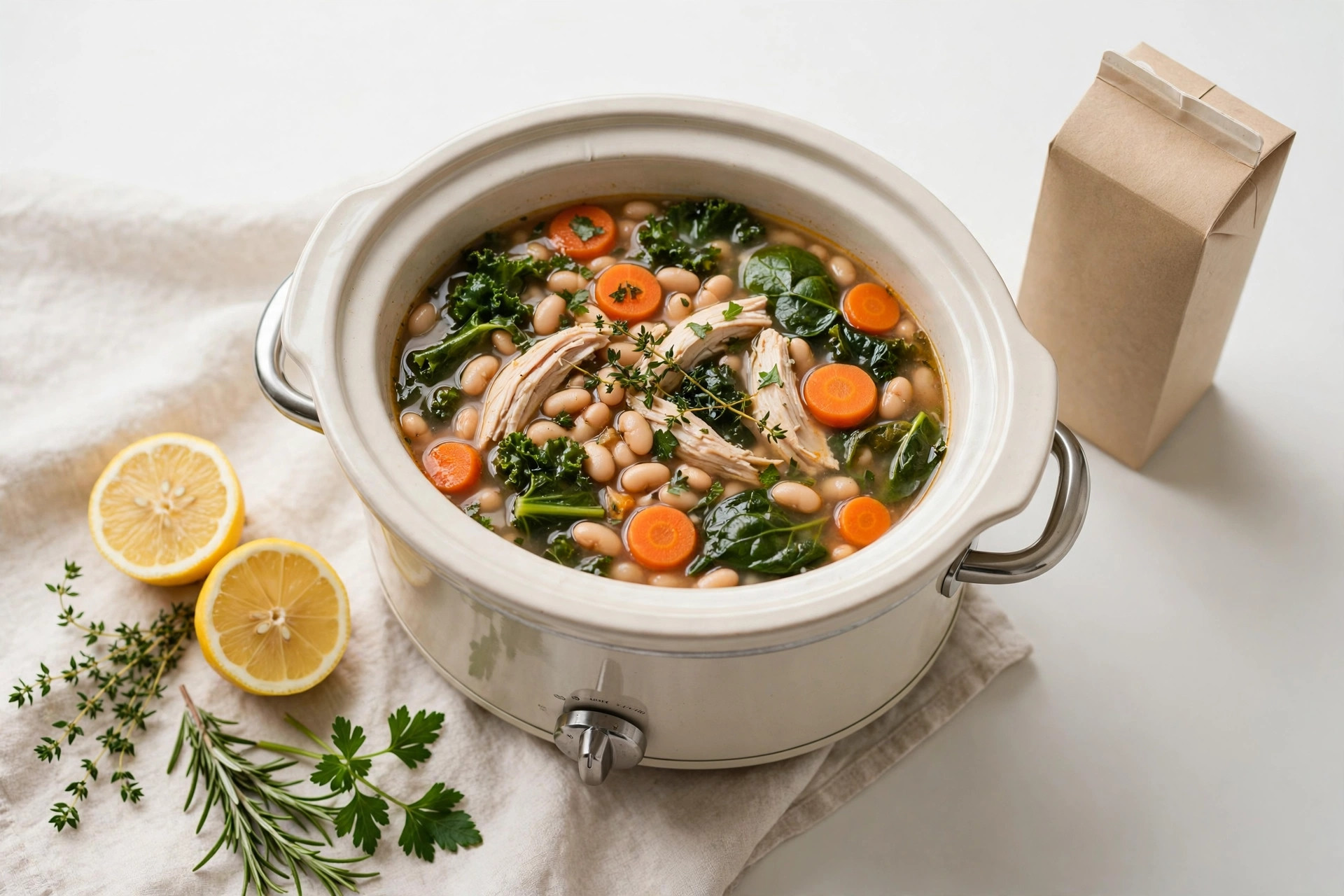
White bean and chicken soup. Fresh chicken, no-salt-added cannellini beans (drained and rinsed), carrots, celery, onion, and garlic in low-sodium broth with rosemary and thyme; spinach stirred in at the end with lemon juice. The beans give the soup body, so nothing creamy or canned is missed.
Chickpea and sweet potato curry. Chickpeas, sweet potato, cauliflower, onion, garlic, and ginger with no-salt-added tomatoes, curry powder, turmeric, and cumin; a finish of lime juice and fresh cilantro. Served over brown rice or quinoa, it is the template that proves the system works with no meat at all.
Herbed pork or chicken with vegetables. Fresh, unprocessed protein with potatoes, carrots, and onions in low-sodium broth, seasoned with a homemade garlic-herb blend instead of a pot-roast packet; a splash of vinegar and chopped parsley at the end replaces the packet's salty punch with a brighter one.
A five-step check to run on any recipe
- Find the liquid. If it is broth, read its milligrams per serving and multiply by the servings in the pot; swap to low-sodium or no-salt-added if the number startles you.
- Find the packet. Any seasoning packet, canned soup, or sauce mix gets replaced with a homemade blend of salt-free spices and herbs.
- Check the cans. Tomatoes and beans become no-salt-added where the store stocks them; beans get drained and rinsed either way.
- Demote the salty garnish. Cheese, cured meat, olives, and pickles shrink to tablespoons, not cups, or leave the dish entirely.
- Plan the finish before you start. Lemon or lime, vinegar, and a fresh herb are on the counter when the lid comes off; taste after they go in, and only then decide whether the dish needs any added salt at all.
What success looks like: a dinner the table eats without comment about what is missing, built from labels you read once and swaps that become habit. The check takes two minutes at the recipe stage and none at the stove, which is the entire point of a slow cooker dinner, low-sodium or otherwise.
FAQ
Is "reduced sodium" good enough? It depends entirely on the starting point, the term only promises at least 25% less than the regular version. Read the milligrams per serving; 140 mg or less per serving is the level that earns the "low sodium" claim.
Does rinsing canned beans really help? Yes, modestly: Extension guidance notes that rinsing canned foods such as beans under running water removes some of the sodium from the canning liquid. It is a supporting step, not a substitute for choosing no-salt-added cans.
What about salt substitutes? Products that replace sodium with potassium are a health decision, not a cooking one, they are unsuitable for some people and some medications. That choice belongs in a conversation with a clinician, not in a recipe, so this guide builds flavour with acid, herbs, and spices instead.
General information only, not medical advice. Sodium figures and label definitions from the National Heart, Lung, and Blood Institute, University of Illinois Extension (citing the CDC), and American Heart Association definitions summarised by UofL Health, checked 2026-10-17.