Slow Cooker Applesauce and Fruit Butters: One Batch, Two Finishes
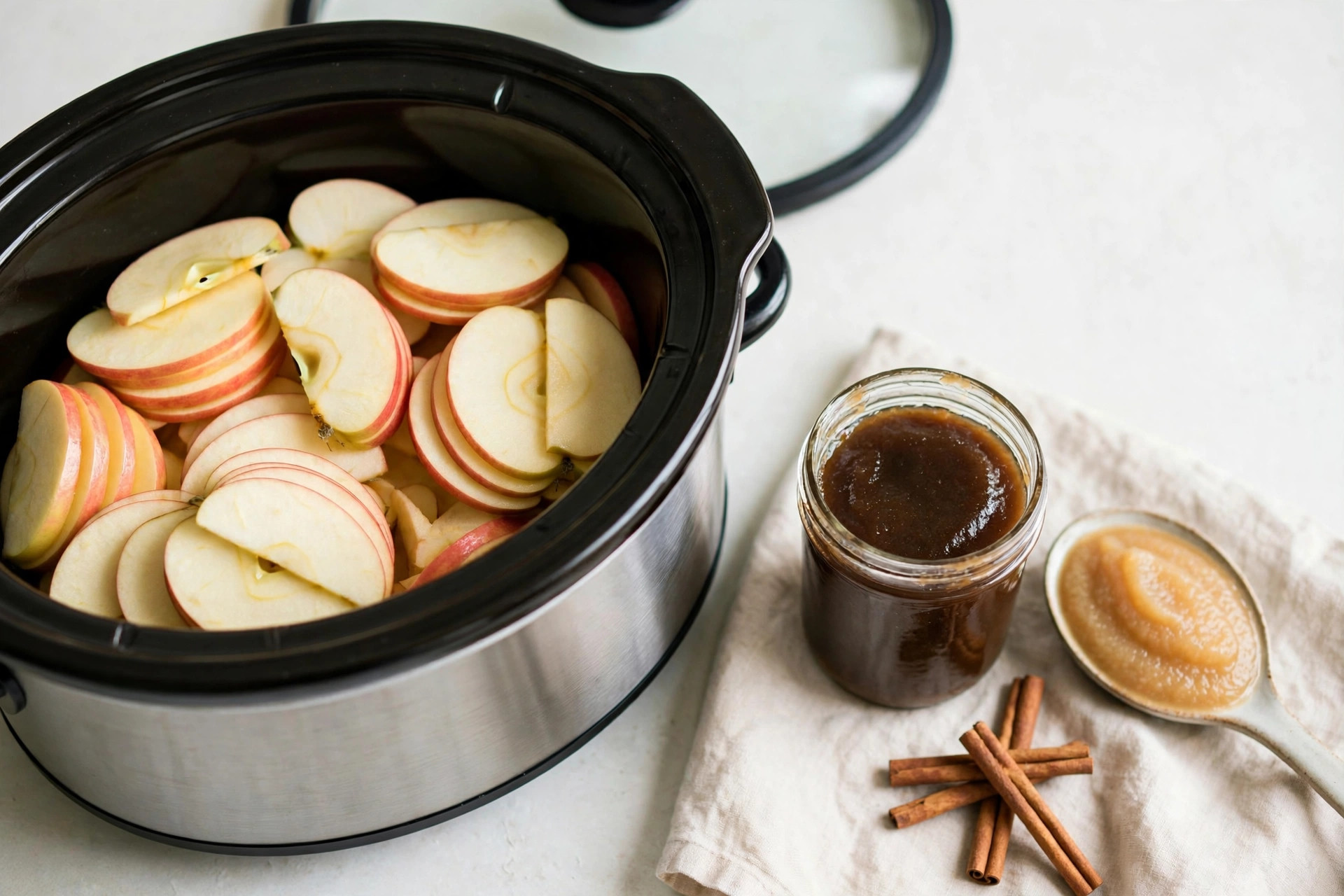
Applesauce and apple butter are not two recipes. They are two stops on the same road: apples cooked soft and smooth, then, if the cook keeps going, cooked down until the water leaves, the sugars concentrate, and the sauce turns into a dark, spreadable butter. The slow cooker is the ideal vehicle for the trip, and also the source of the confusion around it, because published versions disagree about everything that matters: cook it covered for ten hours, cook it uncovered for seven, prop the lid on spoons, do not prop the lid. All of those instructions can be right. They are different settings of a single dial, evaporation, and once the dial is understood, the timing stops being a mystery and the batch becomes adjustable. This guide runs one batch from raw apples to both finishes, tests doneness the way the National Center for Home Food Preservation (NCHFP) tests it, and keeps the three storage lanes, refrigerator, freezer, and canning, properly separate.
The lid is an evaporation dial
A sealed slow cooker traps steam, which condenses and rains back into the food: volume stays nearly constant, which is exactly what soups want and exactly what a butter cannot use. Apple butter thickens only when water escapes. Every lid instruction in the recipe literature is a way of letting it out at a chosen rate. Fully uncovered on High, one applesauce-based recipe finishes in about 7 hours, stirred every 2 hours, the fastest, thirstiest setting, and the one that needs watching near the end. Covered for the long cook and then set slightly ajar, the method in a popular no-sugar-added version, takes about 10 hours covered to reach sauce and 1 to 2 hours more ajar to reduce toward butter. Propped open on two wooden spoons or chopsticks laid across the insert, the arrangement in another well-known recipe, splits the difference for 8 to 10 hours and can run overnight without scorching. None of these is the correct one. Covered makes sauce. Ajar or propped makes butter at a pace a sleeping household can live with. Uncovered makes butter fastest, with the cook awake to stir it.
Sauce, butter, and the pear variation, side by side
| Applesauce | Apple butter | Pear butter | |
|---|---|---|---|
| What it is | The same batch, stopped early | The same batch, reduced by roughly half | The apple-butter template applied to ripe pears |
| Lid | Sealed the whole cook | Sealed until smooth, then ajar, propped, or off | Sealed until smooth, then ajar or propped |
| Texture at the finish | Spoonable, pourable, holds soft peaks | Mounds on a spoon; no liquid rim on a plate (tests below) | Looser than apple butter; stop when it mounds, not by the clock |
| Sugar and spice | Optional; many batches need none | Adjustable to taste, the NCHFP notes sugar and spices can be adjusted or omitted because apples are acidic enough on their own | Gentle spice; pear flavour is quieter than apple |
The comparison carries the article's practical lesson: choose the finish first, because the finish chooses the lid. A cook who wants sauce on Sunday and butter for gifts in December is not making two decisions, it is one batch decision, taken twice a year.
The procedure
- Start with about 6 pounds of apples, a mix of sweet and tart varieties gives the fullest flavour. Wash them, remove stems, and quarter and core them. Peeling is optional at this stage if the batch will be pressed or blended smooth later; the NCHFP procedure cooks quartered, cored fruit and presses it through a colander, food mill, or strainer after softening.
- Put the apples in the cooker with a small amount of liquid, about ¼ cup of water for a no-sugar-added batch, or apple cider for a deeper base. The apples will release far more liquid than they need; the small addition just protects the first hour.
- Cover and cook sealed on Low until the apples have completely collapsed, the no-sugar-added reference batch takes about 10 hours on Low, stirred every few hours if the cook is awake to do it. Shorter, hotter cooks work too; collapsed and soft is the requirement, not the clock.
- Blend or press the soft apples until completely smooth. Stop here, cool, and refrigerate, and the batch is applesauce, the first finish, and a perfectly good place to end.
- For butter: stir in sugar and spices to taste, if using them, cinnamon is the backbone, with nutmeg and cloves in smaller amounts, and vanilla if the batch leans sweet. Nothing in this step is required for safety; it is flavour only.
- Set the lid ajar or prop it on two wooden spoons across the insert, and continue cooking on Low. The reference range is 1 to 2 hours ajar for a modest reduction after a long covered cook, and longer, several more hours, for a deep, dark, firmly spreadable butter. Stir occasionally, and stir more often as it thickens; the bottom is where scorching starts.
- Test for doneness with the NCHFP checks in the next section rather than by colour. When the batch passes, take it off the heat and let it cool before jarring.
What success looks like: a spoonful of the finished butter sits mounded instead of slumping flat, a small spoonful on a plate shows no ring of liquid around its edge after a minute, and the flavour tastes concentrated, apple first, spice second, rather than watery-sweet. Colour follows thickness; thickness does not follow colour, which is why the tests below, and not the shade of brown, call the finish.
Done means tested, not dark
The NCHFP's apple butter procedure, adapted from the USDA Complete Guide to Home Canning, gives two doneness tests, and both are worth more than every colour chart on the internet. First: remove a spoonful and hold it away from the steam for 2 minutes; the butter is done if it remains mounded on the spoon. Second: spoon a small quantity onto a plate; when a rim of liquid does not separate around the edge of the butter, it is ready. The tests work because they measure the thing that matters, free water, directly. A batch can be deeply brown and still watery if the apples were juicy and the lid stayed sealed, and a paler batch can pass both tests cleanly. Run both. They take two minutes at the end of a ten-hour cook, and they are the difference between apple butter and spiced applesauce with ambitions.
Storage in three lanes: fridge, freezer, tested canning
Refrigerator. Cooled applesauce and apple butter keep in the refrigerator for everyday use; apple butter stored this way should be used within about 3 weeks, per the storage guidance that accompanies tested-recipe summaries.
Freezer. For longer keeping without canning, freeze the cooled butter in jars or containers with headspace for expansion. Guidance accompanying tested recipes puts frozen apple butter at up to about 6 months for best quality; an applesauce-based recipe at the fast, uncovered end of the method freezes its finished butter for up to 3 months. Thaw in the refrigerator and stir well before serving.
Canning, only with a tested recipe. Shelf-stable canning is not a storage improvisation; it is a procedure with numbers, and the numbers come from the tested source, not from the slow cooker batch. The NCHFP apple butter procedure, 8 pounds of apples yielding about 9 to 10 pints, specifies filling hot butter into sterile half-pint or pint jars leaving ¼-inch headspace, then processing in a boiling-water canner: half-pints and pints for 5 minutes at 0 to 1,000 feet elevation, 10 minutes at 1,001 to 6,000 feet, and 15 minutes above 6,000 feet; quarts take 10, 15, and 20 minutes at the same elevations. Anyone canning should work from the NCHFP procedure itself, start to finish, including its jar preparation and altitude table, and any jar that does not seal gets refrigerated, not shelved.
FAQ
Can store-bought applesauce be the starting point? Yes, several established recipes do exactly that, stirring spices and sugar into unsweetened applesauce and going straight to the reduction stage. The batch simply skips steps 1 to 4 of the procedure and starts at the lid-ajar cook.
Why did the butter stay thin after hours of cooking? Almost always the lid: sealed or nearly sealed, the steam condenses and returns, and no reduction happens no matter how long the cook runs. Prop the lid, give it time, and judge by the spoon and plate tests, not the clock.
Is the sugar required? No. Sugar and spices are flavour choices in fruit butters, they can be adjusted or left out, and a no-sugar-added batch of sweet apples makes a respectable butter on its own. A plainer batch may simply take a little longer to thicken.
Doneness tests, headspace, and canning process times from the National Center for Home Food Preservation's apple butter procedure (USDA Complete Guide to Home Canning, revised 2015), checked 2026-10-17. For canning, follow a current tested recipe exactly; when in doubt, refrigerate or freeze instead.