Slow cooker lamb shanks: still tough means not done yet
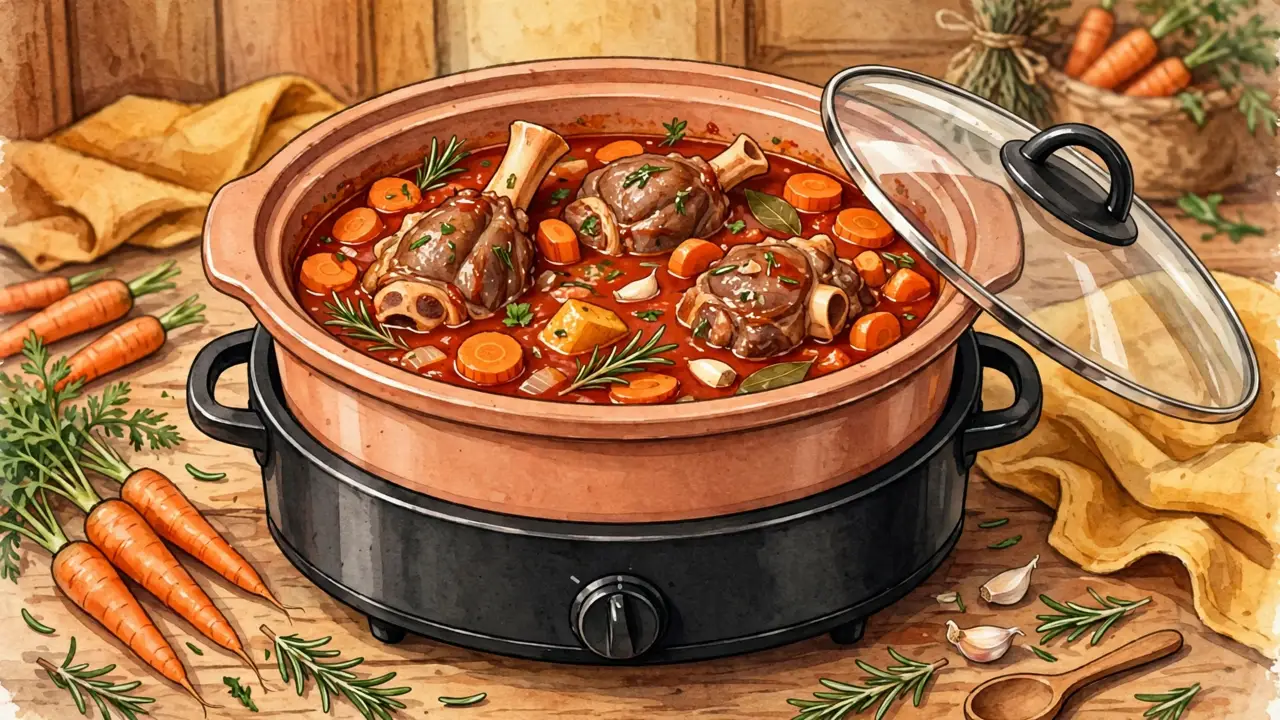
The dish at a glance: four lamb shanks, browned first, then cooked on Low for 7 to 8 hours in a tomato and stock sauce until the meat pulls from the bone. High takes 4 to 5 hours. Prep is about 15 minutes. The most common failure has a counterintuitive fix, covered below: a shank that is still tough at the stated time almost always needs more time, not less.
Ingredients
- 4 lamb shanks, about 1.4 kg (3 lb) total for small shanks
- 2 tbsp plain flour, seasoned with salt and pepper
- 2 tbsp olive oil
- Onion and carrots, chopped; garlic, crushed
- Tomato puree and tinned tomatoes
- Stock, plus rosemary and bay leaves
- Optional: a glass of red wine, replaced with extra stock for the no wine path
Whole shanks need room. An oval slow cooker fits them without stacking, and stacking changes the timing.
Method
- Brown the shanks (8 to 10 minutes per batch). Toss the shanks in the seasoned flour. Heat the oil in a large frying pan and brown on all sides, working in batches so they colour rather than steam. Transfer to the slow cooker.
- Build the base (5 to 6 minutes). In the same pan, cook the onion and carrots until starting to soften, add the garlic and tomato puree, and cook 1 minute more. Add to the cooker.
- Add liquid and herbs. Pour in the stock (and wine, if using), and add the tomatoes, rosemary, and bay. Liquid should come partway up the shanks; it does not need to cover them.
- Cook low and slow. Cover and cook on Low for 7 to 8 hours, or on High for 4 to 5 hours. Done looks like this: a fork slips easily in and out of the meat, and the meat pulls away from the bone with almost no resistance.
- Finish the sauce (10 to 15 minutes). Lift the shanks out and keep them warm. If the sauce is thin, simmer it uncovered in a pan for 10 to 15 minutes until it coats the back of a spoon, then season and pour over the shanks.
Troubleshooting, in the order to try it
| Problem | Likely cause | Fix |
|---|---|---|
| Meat still tough at 7 hours | Undercooked; slow cookers vary | Add 125 ml (half a cup) of broth and cook 1 to 2 hours more on Low |
| Large shanks not tender on schedule | Size; bigger shanks need more time | Add 1 hour on Low or 30 minutes on High beyond the base timing |
| Sauce watery at serving | Braising liquid never reduced | Simmer uncovered 10 to 15 minutes before serving |
| Meat tender but bland | Shanks went in unbrowned | Brown first next time; this step carries the deep flavour |
Storage and reheating
Refrigerate leftovers within 2 hours, keep the fridge at 4 °C (40 °F) or lower, and use within 2 to 4 days. Reheat gently on the stovetop or covered in a 163 °C (325 °F) oven for 25 to 30 minutes, with a splash of stock if the sauce has thickened in the fridge, until hot throughout and leftovers reach 74 °C (165 °F).
Food safety note: storage and reheating guidance follows Health Canada general food safety advice, checked November 21, 2026.
Choosing shanks that fit the timing
The base timing assumes small shanks, four of them totalling about 1.4 kg (3 lb). Shanks are sold at very different sizes, and the cut gives no visual warning that a batch is oversized until the clock runs out. Weigh or ask. A batch well above that total is not a failed recipe; it is the larger shank case in the troubleshooting table, and it wants its extra hour on Low planned from the start rather than discovered at serving time.
Fit matters as much as weight. Shanks cook in a single layer, partly covered by liquid, and a crowded cooker where shanks stack on each other cooks unevenly, with the buried pieces lagging behind. An oval cooker suits the shape. If the batch does not fit in one layer, cook fewer shanks well rather than more shanks unevenly, and freeze the rest raw for another day.
Serve the shanks whole, one per plate, with the reduced sauce spooned over. The meat should yield to a spoon at the table. If it needs a knife and determination, it needed the extra hour, and the honest move is to note the batch weight for next time, because shank size, not the recipe, was the variable.
— June Callahan, Food Writer