Slow Cooker Pulled Chicken for Weeknight Tacos
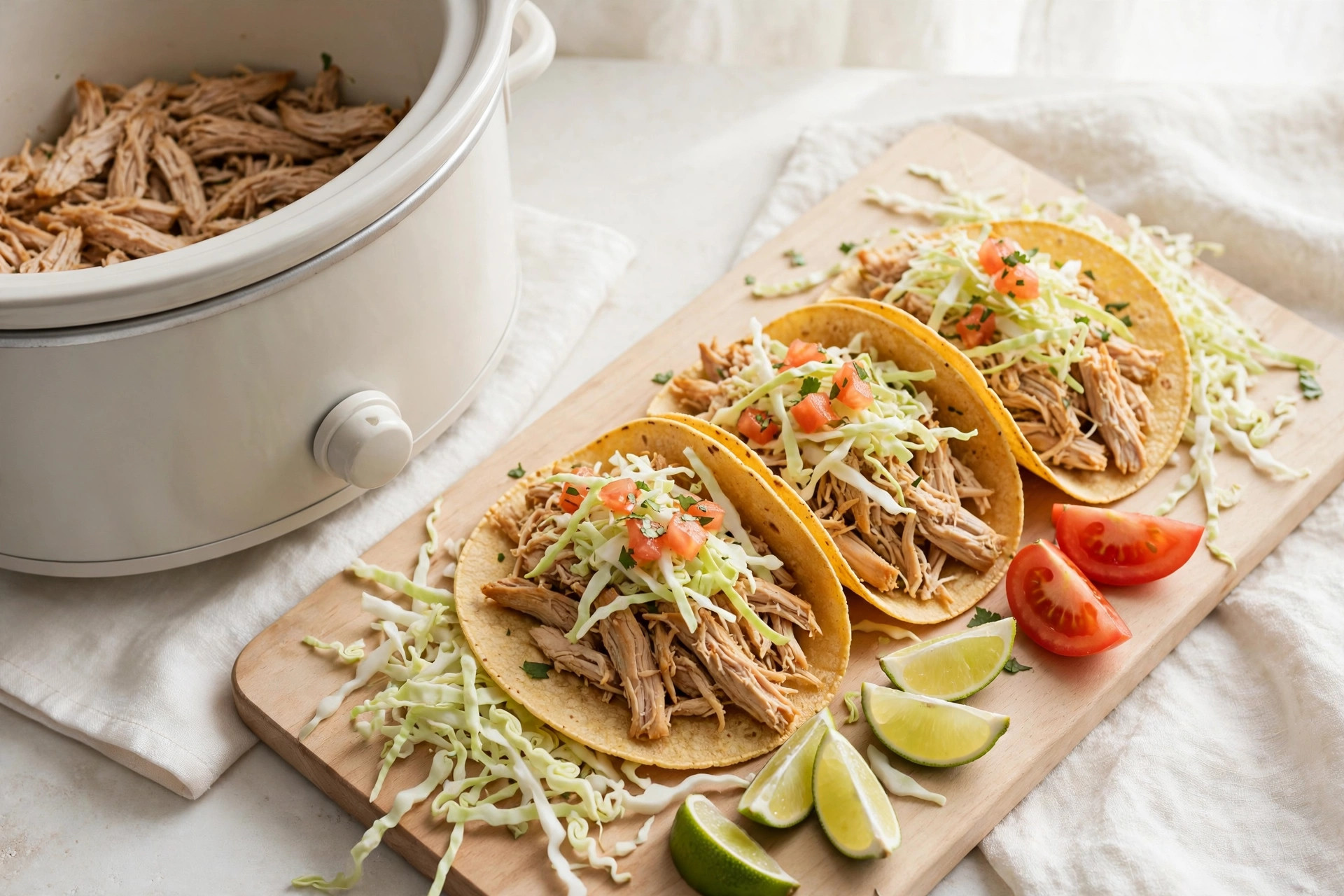
Taco chicken is the slow cooker recipe everyone thinks they already know: chicken, salsa, seasoning, wait, shred. The trouble hides in the word wait. Published versions of this exact dinner disagree by hours, thighs at 4 to 5 hours on Low in one, a single chicken breast at 8 hours on Low in another, and almost none of them tell you how to confirm the chicken is actually done, as opposed to merely shreddable. Shreddable and safe usually arrive together, but they are not the same event, and dry chicken is what happens when a cautious cook splits the difference by adding another hour. This version closes both gaps: a cut comparison so the timing window matches the day you actually have, and a thermometer check, 165 °F, that replaces guesswork at the one moment it matters.
Breast or thigh: pick the cut that matches your day
| Boneless, skinless breast | Boneless, skinless thigh | |
|---|---|---|
| Cooking window used here | Low 3 to 4 hours, or High 2 to 2½ hours | Low 4 to 5 hours, or High 2½, 3 hours |
| Forgiveness | Low, lean meat dries quickly past done; an extra hour costs real moisture | High, fat and connective tissue keep it juicy well past the minimum time |
| Shred | Long, distinct strands; best for a lighter taco | Shorter, richer shreds; stands up to bold seasoning and reheating |
| Best for | A cook who is home to check it on time | A workday cook who needs the window to flex by an hour or more |
Those windows are deliberately shorter than the longest ones in circulation. An 8-hour Low cook for a lone chicken breast, as one popular small-batch recipe directs, produces chicken that is safe many times over and dry in a way no amount of salsa repairs. The long windows persist because they are forgiving of forgotten dinners, not because the chicken needs them. If dinner has to sit unattended for a full workday, the honest answer is thighs, or a different recipe, rather than breasts left to overcook on a timer's say-so. Either cut must start fully thawed: Michigan State University Extension's slow-cooker guidance is explicit that meat and poultry always go in thawed, because a frozen centre spends too long crossing the temperature range where bacteria multiply.
The base: salsa does three jobs, seasoning does the fourth
For about 1½ pounds of chicken, enough for roughly 12 tacos, the pot needs very little: the chicken, about 1½ to 2 cups of chunky salsa, and the equivalent of one packet of taco seasoning (roughly 3 tablespoons), or a homemade blend of chili powder, cumin, paprika, oregano, and garlic powder in the same spirit. The salsa is not a garnish here. It is the cooking liquid that keeps the chicken braising rather than steaming in its own juices, the acid that brightens a long cook, and most of the vegetable content, all in one jar. Chunky beats thin because the pieces hold some texture through the cook. Peppers and onions sliced and added on top cook down into the sauce; anyone who wants them with bite should hold them back and stir them in after shredding, warmed through for about 10 minutes on High, a small staging trick borrowed from the better versions of this recipe. No extra liquid is needed, and adding broth on top of salsa is how taco chicken turns into soup.
The procedure
- Thaw the chicken fully in the refrigerator if it was frozen. Pat it dry and season all over with the taco seasoning.
- Pour half the salsa into the cooker and spread it across the bottom. Lay the chicken in a single layer, the cooker should end up between half and two-thirds full once everything is in, the fill range Extension guidance recommends.
- Spoon the remaining salsa over the top. Add sliced onion and peppers now for a soft, sauce-ready result, or hold them for the finish (step 6).
- Cover and cook: breasts on Low 3 to 4 hours or High 2 to 2½ hours; thighs on Low 4 to 5 hours or High 2½, 3 hours. Keep the lid on. Extension guidance notes each lift drops the temperature 10 to 15 degrees.
- Verify, do not guess: insert a food thermometer into the thickest part of the largest piece. FoodSafety.gov's safe minimum internal temperature chart sets all poultry, breasts, thighs, every cut, at 165 °F (74 °C). Below that, cover and give it 20 to 30 more minutes, then check again. This check is the article's whole argument in one motion: time windows plan the evening, the thermometer ends the cook.
- Move the chicken to a board or wide bowl and shred it with two forks. If you held the peppers and onions back, stir them into the hot cooking liquid in the cooker now.
- Return the shredded chicken to the cooker and toss it through the liquid. If the mixture looks soupy, ladle off some liquid into a cup, you can add it back spoonful by spoonful, but a flooded taco cannot be unflooded at the table.
- Warm the tortillas, build the tacos, and serve with the toppings cold and fresh: shredded lettuce or cabbage, diced tomato, cheese, sour cream, lime wedges.
What success looks like: the chicken pulls into strands with light fork pressure rather than crumbling into chalk, the thermometer read 165 °F before shredding, and each tortilla holds moist, sauced chicken that does not drip cooking liquid down your wrist. Two of those three are texture; the middle one is the one that keeps everyone safe.
Holding and serving without drying it out
Shredded chicken holds well because it sits in its own seasoned liquid, which is also why the shred should happen in or near the pot rather than on a dry board across the kitchen. For a serving window, family members drifting in over an hour, a second round after a game, keep the cooker on Warm with the shredded chicken in its liquid and the lid on. Warm is a holding setting for food that is already cooked and hot, and this is exactly its job. Stir before each serving; the pieces at the edges dry first. If the hold will stretch past about two hours, the better move is to refrigerate the chicken in its liquid and reheat portions as needed, following the rules below, rather than parking it warm all evening.
Leftovers: the 3-to-4-day clock, and never reheat in the cooker
Taco chicken makes excellent leftovers, on a schedule. USDA FoodKeeper guidance, as summarised in leftover storage tables drawn from USDA sources, gives cooked chicken 3 to 4 days in the refrigerator at 40 °F and up to 4 months in the freezer at 0 °F for best quality. Refrigerate it in its liquid in a shallow container so it cools quickly, and freeze it the same way, the liquid protects the shred from freezer dryness and thaws back into a sauce. One rule surprises people: do not reheat leftovers in the slow cooker. Extension guidance is direct on this, a slow cooker warms food too slowly through the danger zone, so leftovers reheat on the stovetop, in the microwave, or in the oven until they reach 165 °F, the same number FoodSafety.gov lists for leftovers of any type. A skillet with a splash of the reserved liquid brings taco chicken back in minutes, with better texture than the cooker would manage anyway.
FAQ
Can the chicken cook from frozen to save time? No. Extension and USDA guidance is to thaw poultry fully before slow cooking; a frozen centre spends hours in the temperature range where bacteria grow. Thaw in the fridge overnight and the morning takes thirty seconds.
The chicken is shreddable but the thermometer says 158 °F. Is it done? Not yet. Shreddability is a texture cue, not a safety measurement. Cover it, cook 20 to 30 minutes more, and check the thickest piece again for 165 °F.
Breasts came out dry. What went wrong? Almost always time, not temperature: breasts held an hour or two past done lose moisture no sauce can replace. Next time choose thighs for a long window, or shorten the breast window and trust the thermometer to call the finish.
Food-safety temperatures and storage times from FoodSafety.gov, Michigan State University Extension, and USDA FoodKeeper guidance, checked 2026-10-17. When in doubt about a specific food or situation, follow current USDA Food Safety and Inspection Service guidance.